

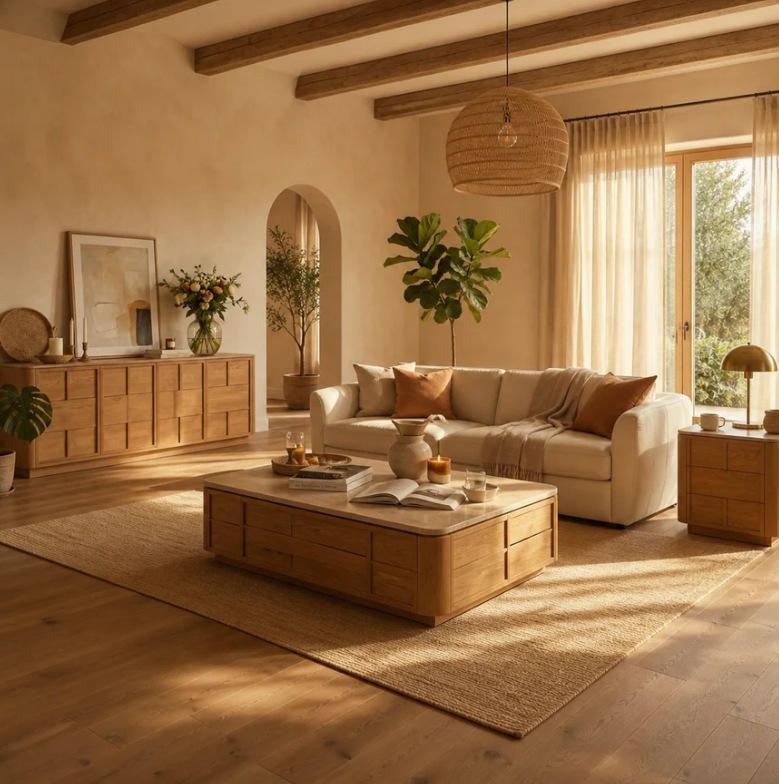
A well-designed interior does not always come from choosing furniture that matches. Some of the most interesting spaces bring together pieces with different shapes, silhouettes, and visual characteristics while maintaining a clear sense of unity.
The secret is not uniformity, but a shared design language.
When furniture pieces relate to one another through their forms, lines, finishes, or overall character, a room can feel cohesive without appearing overly coordinated. Each piece has its own identity, yet contributes to a larger composition.
Understanding this relationship offers a more flexible approach to furnishing a home, allowing individual choices to feel intentional rather than disconnected.

What Is a Design Language in Furniture?
Every piece of furniture communicates something through its design.
A table with clean lines and a restrained silhouette creates a different impression from one with sculptural curves or elaborate detailing. A cabinet with a strong geometric form feels different from a piece defined by softer edges and rounded corners.
These characteristics form a piece's design language.
In an interior, the design language emerges from the relationship between multiple objects. Furniture does not need to share the same designer, collection, or period to work together. What matters is whether certain visual qualities connect the pieces.
These connections might be subtle: a repeated curve, a similar leg profile, a consistent level of visual simplicity, or a relationship between solid forms and open structures.
Once these connections become clear, it becomes easier to combine furniture with confidence.
Start With Shapes, Not Matching Sets
Matching furniture sets offer an easy way to create consistency, but they are not the only way to achieve a cohesive interior.
Combining different silhouettes can create a more individual and layered result.
Consider a dining room with a rectangular table, rounded dining chairs, and a pendant light with an organic form. The shapes are different, but their contrast can make the composition more interesting.
The same principle applies in a living room. A linear sofa can be paired with a rounded coffee table, while a more sculptural accent chair introduces another shape without disrupting the overall arrangement.
The key is to create a relationship between the forms rather than repeating the same shape everywhere.
A few deliberate connections are often more effective than making every element identical.
Balance Straight Lines With Softer Forms
One of the most useful ways to establish a shared design language is through the relationship between geometric and organic shapes.
Straight lines can introduce structure and clarity. Curves can soften that structure and make an interior feel more relaxed.
A room filled entirely with rigid geometric forms may feel overly formal, while a composition dominated by rounded silhouettes can lack definition.
Combining the two creates contrast.
For example, a rectangular dining table can be complemented by chairs with curved backs. A linear console can sit beneath a rounded mirror. In a living room, a structured sofa can be balanced by an oval coffee table.
These combinations work because each form gives the other something to respond to.
Rather than competing for attention, the different shapes contribute to a more complete visual composition.
Repeat Details Without Repeating Everything
Cohesion often comes from small details that appear in different places throughout a room.
A tapered furniture leg might relate to the profile of a nearby chair. Rounded corners on a coffee table might echo the shape of a mirror or lighting fixture. A consistent approach to hardware and detailing can connect otherwise different storage pieces.
These repetitions help the eye move naturally through the space.
However, repeating every detail can make an interior feel predictable. The objective is to establish a visual connection while allowing individual pieces to retain their character.
Think of these details as a recurring theme rather than a strict formula.
A room feels considered when its elements communicate with one another, not when every element looks the same.
Use Contrast to Give Each Piece a Role
A cohesive room still needs variation.
If every piece has the same visual weight, shape, and character, the composition may feel flat. Contrast creates hierarchy by allowing certain elements to lead while others provide support.
A sculptural dining table might serve as the central feature of a room, while simpler chairs allow its form to stand out. In a living area, a distinctive coffee table can become a focal point against a quieter sofa and restrained accessories.
This does not mean every room needs a dramatic statement piece.
Sometimes the most effective composition comes from several understated elements working together, with no single object demanding all the attention.
The important thing is to understand the role each piece plays and how it contributes to the overall design.
Consider the Room as a Complete Composition
Furniture decisions become easier when they are evaluated in relation to the entire room.
Before introducing a new piece, consider the furniture already in place. Look at the dominant shapes, the amount of visual detail, and the overall character of the interior.
Ask yourself a few simple questions:
-
Does the new piece reinforce an existing design quality or introduce a useful contrast?
-
Are there details that connect it to the surrounding furniture?
-
Does it add a new dimension to the room without making the composition feel crowded?
-
Does it serve a practical purpose as well as a visual one?
These questions help move furniture selection beyond individual preferences and toward a more considered approach.
The goal is not to follow a fixed set of rules, but to understand why certain combinations feel natural.
Creating a Home That Feels Collected, Not Coordinated
A home becomes more personal when its furnishings reflect different choices made over time.
A dining table may be selected for its proportions, a chair for its comfort, and a console for its sculptural quality. These pieces can come together successfully even when they were never designed as a matching set.
A shared design language provides the connection.
By paying attention to form, detail, contrast, and overall character, it is possible to create interiors that feel intentional without losing individuality.
This approach also allows a home to evolve. New pieces can be introduced as needs and preferences change, provided they contribute meaningfully to the existing composition.
The Art of Bringing Different Pieces Together
Good interior design is not simply about finding beautiful furniture. It is about understanding how different objects relate to one another.
Shapes create rhythm. Repeated details establish connections. Contrast adds character. Together, these elements form a design language that gives a room its identity.
At Karhyn, we believe thoughtful furniture design is as much about these relationships as it is about the individual piece. When form and function work together within a considered composition, furniture can bring clarity and character to a space without requiring everything to match.
A cohesive interior does not need uniformity. It needs a point of view.


